Some are sooo good, they need their own page.
Holy Ghost by XKCD. Most beautifully, the original alt-text concluded: 'Okay everyone, cross yourselves, then cross the streams.'

Monday, 17 October 2011


Friday, 7 October 2011
Wednesday, 5 October 2011
Charles V
 |
| Charles I, II, III, IV & V |
Firstly, and it may be misattributed, but he is supposed to have said:
"I speak Spanish to God, Italian to Women, French to Men, and German to my Horse."
File that under 'I'm choosing to believe it, even if it isn't true.'
Secondly, he appears in another opera, Ernani, also by Verdi (never heard of it). It features his election as Holy Roman Emperor. Which is nice.
Thirdly, I mentioned he was Charles I as King of Spain and Charles V as Holy Roman Emperor. Well, it gets better even than that. Yes, I know, unbelievable.
He was Charles II in his capacity as the Duke of (amongst other places) Burgundy, Brabant and Luxembourg, and Charles III as the Duke of Guelders and the Count of Flanders, as well as being counted Charles IV as the King of Naples. That's pretty damn impressive and, I think, means he gets to build hotels without needing to buy four green houses first.
Lastly, here, in full, is his titulature:
Charles, by the grace of God, Holy Roman Emperor, forever August, King of Germany, King of Italy, King of all Spains, of Castile, Aragon, León, Navarra, Grenada, Toledo, Valencia, Galicia, Majorca, Sevilla, Cordova, Murcia, Jaén, Algarves, Algeciras, Gibraltar, the Canary Islands, King of Two Sicilies, of Sardinia, Corsica, King of Jerusalem, King of the Western and Eastern Indies, Lord of the Islands and Main Ocean Sea, Archduke of Austria, Duke of Burgundy, Brabant, Lorraine, Styria, Carinthia, Carniola, Limburg, Luxembourg, Gelderland, Neopatria, Württemberg, Landgrave of Alsace, Prince of Swabia, Asturia and Catalonia, Count of Flanders, Habsburg, Tyrol, Gorizia, Barcelona, Artois, Burgundy Palatine, Hainaut, Holland, Seeland, Ferrette, Kyburg, Namur, Roussillon, Cerdagne, Zutphen, Margrave of the Holy Roman Empire, Burgau, Oristano and Gociano, Lord of Frisia, the Wendish March, Pordenone, Biscay, Molin, Salins, Tripoli and Mechelen.King of all Spains and Two Sicilies! I hope you all feel suitably humble.
Intersection

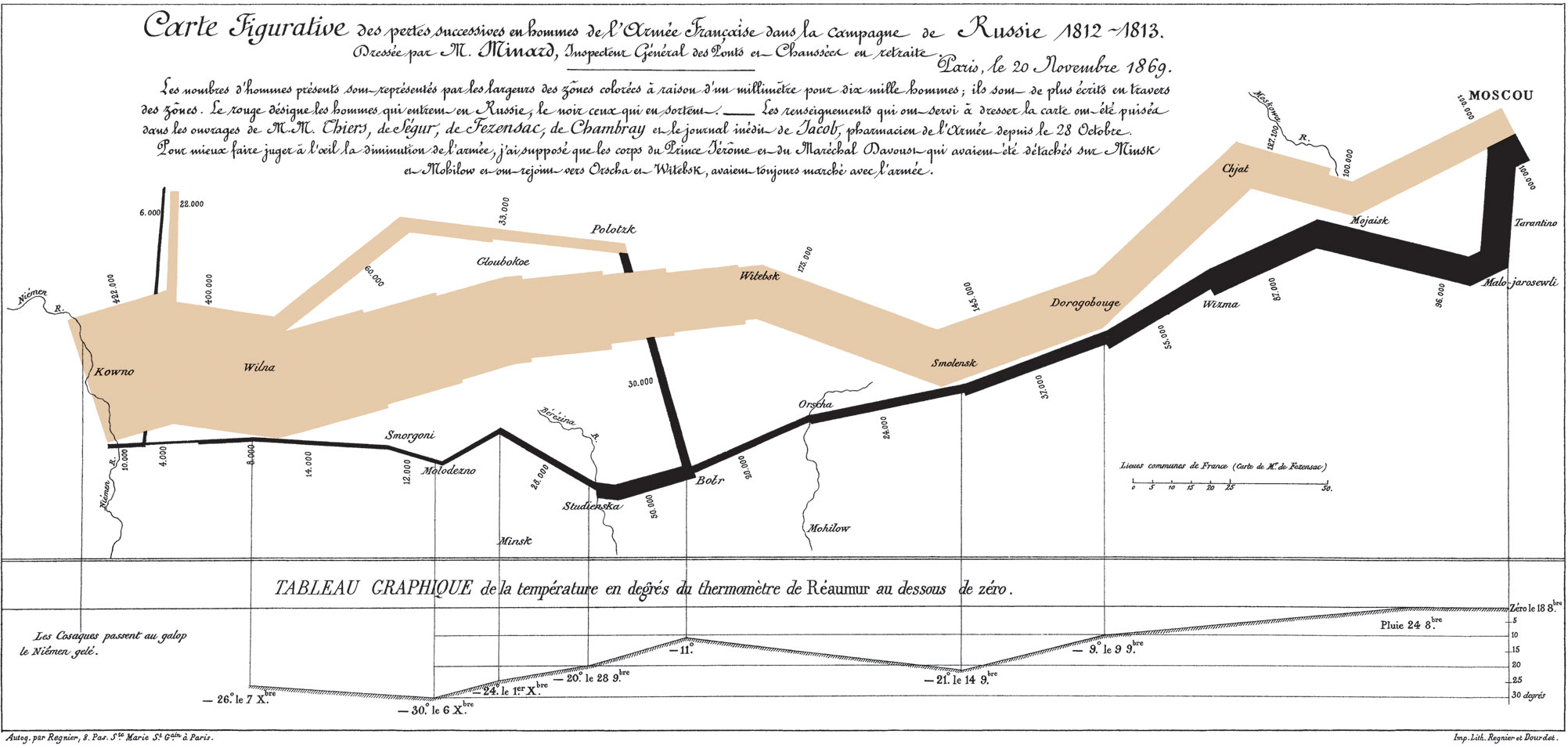
It's not just a recent trend either. Talking to my son about the Napoleonic Wars this week, I remembered this 'carte figurative' by Charles Joseph Minard. It's a flow chart showing the size of the French army both marching to and retreating from Moscow during the catastrophic invasion of Russia in 1812. The chart was drawn up in 1869. It not only shows the rise and fall of troop numbers and the route of the march (including things like river crossings), it also marks the time taken and, perhaps most significantly, the temperature during the long winter. It's already taken longer for me to type this explanation than it would for you, just by looking at the chart, to understand what happened to the French army. It's a meticulous work of genius.
 |
| Click here to view full size. |
This almost counts as a commission I suppose. My wife (you might know her) works for Houston Grand Opera and their upcoming season includes Don Carlos, by Verdi, and Maria Stuarda, by Donizetti, which both happen to be about real historical figures from sixteenth century Europe. The eponymous pair being, respectively, Charles, oldest son, and heir, of Philip II of Spain and Mary, Queen of Scots. Now, I read History at university, and the sixteenth century was my thing. By which I mean, it is the bit I remember best and therefore am most confident bluffing about. So when L asked if these two people were related, I was more than happy to get out my books and start scouring the genealogies.
The answer is, yes, of course they are: the ruling houses of Europe were very tightly bound together during this period. I had lots of fun finding out exactly how and even more fun drawing it up, especially once I discovered that some of the connecting people had also found their way into operas.

Here's the finished chart. It's simplified, only showing spouses/siblings where they are necessary, and there is one deliberate inaccuracy: Elizabeth de Valois was younger than her brother François II, not older, but showing it the other way around would mean having MQS appearing twice or even the whole thing going around in a scrolling loop! That would work nicely on screen, but on the printed page it just wouldn't do.
There's one other simplification that I had to make. Philip's father Charles is shown as being 'Charles V of Spain' but, of course, he was no such thing. He is really Charles the first of Spain and the fifth as Holy Roman Emperor, but is always known as Charles V. Interestingly, Spain went on and had another three Charleses, so if they had one more, he would be 'Charles V of Spain' and a lot of history books - and this chart - would suddenly make a lot less sense.
Thursday, 29 September 2011
Aliens vs Mayans
I'm not one for a conspiracy theory. Conspiracies are seductive and slick, but the truth is surely always actually a messy contradictory affair. So I am happy to debunk a cosy little theory that I knitted together on Twitter this morning.
It started with this Guardian article which relates, with a remarkable lack of cynicism, that the Mexican government is cooperating with a new documentary movie which will reveal how aliens interacted with ancient Mayan people. No, really.
(Well, Caballeros is actually the president of Guatemala, which is also involved apparently, but never mind that.) You can't see me, but I am still rolling my eyes in disgust at this, but please, I have to deal with the speck in my own eye before I can take a chainsaw to theirs.
In a nutshell, this article caused me to 'go off on one' on Twitter and I mentioned at one point that this was an indication of the awful state of the Mexican tourism industry: that they were now so desperate to make people visit their country that they were prepared to "literally say anything". And, thinking that I really had to get this off my chest properly, I then sauntered over to Google to find a lovely graph showing how US and European tourists were avoiding Mexico.
Well, guess what. I couldn't find one. No one would deny that there are massive problems. This from the Washington Post, April 2009, reveals the impact of Swine Flu, with resorts running at 20% occupancy rates. And this was after the effects of drug cartel violence had begun to be noticed, as this (from the same month) shows. I'm guessing the global economic hoo-ha doesn't help much either.
But things have been improving, albeit from a catastrophically low base. The LA Times reported that visitor numbers for 2010 were up 17.8% on the previous year, in fact, with the trend set to continue in 2011.
So, despite 35,000 deaths over four years, a US State Department travel warning, slashed prices and a promotional tour to the US during which the president Felipe Calderón has resorted to pimping a PBS travel series, I draw the line at accusing the Mexican government of conspiring to fraudulently claim the country contains sites of contact with extra-terrestrials in order to boost tourism.
Because the whole thing is preposterous.
As the Guardian later makes clear, despite the fervent publicity-garnering quotes from the producers, the highest ranking name attached to the project from the Mexican government is Luis Augusto García Rosado, minister of tourism for the Mexican state of Campeche. A glittering career awaits, presumably? But surely nobody with pretensions to political credibility is going to want to be connected with this.
I haven't seen the film, no-one has yet, and I reserve the right to change my mind once I have. But the likelihood that they will be able to produce the sort of evidence that would persuade me is very very small.
What annoys me most about the 'aliens/early civilisation' theory is that we are so ready to belittle the incredible achievements of these societies. Like us, these people struggled against disease, weather, competitors and yet with rudimentary technology produced some of the most amazing artefacts in human history. Archaeologists and historians devote their lives to understanding what these people believed and thought, and how their societies functioned. But we, knowing better, feel the need to attribute the credit to unknown magic powers. It's as if sites like Stonehenge, the Pyramids, the Nazca Lines or Chichen Itza weren't impressive enough by themselves.
But then conspiracy theories are, of course, the preserve of those who are never satisfied with what's staring them in the face.
It started with this Guardian article which relates, with a remarkable lack of cynicism, that the Mexican government is cooperating with a new documentary movie which will reveal how aliens interacted with ancient Mayan people. No, really.
Producer Raul Julia-Levy said the documentary-makers were working in cooperation with the Mexican government for what he said was "the good of mankind". He said the order to collaborate had come directly from the country's president, Álvaro Colom Caballeros.
"Mexico will release codices, artefacts and significant documents with evidence of Mayan and extraterrestrial contact, and all of their information will be corroborated by archaeologists," he said. "The Mexican government is not making this statement on their own – everything we say, we're going to back it up."
(Well, Caballeros is actually the president of Guatemala, which is also involved apparently, but never mind that.) You can't see me, but I am still rolling my eyes in disgust at this, but please, I have to deal with the speck in my own eye before I can take a chainsaw to theirs.
In a nutshell, this article caused me to 'go off on one' on Twitter and I mentioned at one point that this was an indication of the awful state of the Mexican tourism industry: that they were now so desperate to make people visit their country that they were prepared to "literally say anything". And, thinking that I really had to get this off my chest properly, I then sauntered over to Google to find a lovely graph showing how US and European tourists were avoiding Mexico.
Well, guess what. I couldn't find one. No one would deny that there are massive problems. This from the Washington Post, April 2009, reveals the impact of Swine Flu, with resorts running at 20% occupancy rates. And this was after the effects of drug cartel violence had begun to be noticed, as this (from the same month) shows. I'm guessing the global economic hoo-ha doesn't help much either.
But things have been improving, albeit from a catastrophically low base. The LA Times reported that visitor numbers for 2010 were up 17.8% on the previous year, in fact, with the trend set to continue in 2011.
So, despite 35,000 deaths over four years, a US State Department travel warning, slashed prices and a promotional tour to the US during which the president Felipe Calderón has resorted to pimping a PBS travel series, I draw the line at accusing the Mexican government of conspiring to fraudulently claim the country contains sites of contact with extra-terrestrials in order to boost tourism.
Because the whole thing is preposterous.
As the Guardian later makes clear, despite the fervent publicity-garnering quotes from the producers, the highest ranking name attached to the project from the Mexican government is Luis Augusto García Rosado, minister of tourism for the Mexican state of Campeche. A glittering career awaits, presumably? But surely nobody with pretensions to political credibility is going to want to be connected with this.
I haven't seen the film, no-one has yet, and I reserve the right to change my mind once I have. But the likelihood that they will be able to produce the sort of evidence that would persuade me is very very small.
What annoys me most about the 'aliens/early civilisation' theory is that we are so ready to belittle the incredible achievements of these societies. Like us, these people struggled against disease, weather, competitors and yet with rudimentary technology produced some of the most amazing artefacts in human history. Archaeologists and historians devote their lives to understanding what these people believed and thought, and how their societies functioned. But we, knowing better, feel the need to attribute the credit to unknown magic powers. It's as if sites like Stonehenge, the Pyramids, the Nazca Lines or Chichen Itza weren't impressive enough by themselves.
But then conspiracy theories are, of course, the preserve of those who are never satisfied with what's staring them in the face.
Tuesday, 27 September 2011
Your Five A Every-So-Often
Five more gems from XKCD.
Duty Calls
Jealousy
Making Hash Browns
Fortune Cookies
Purity (I guess History is just applied Sociology..)
Duty Calls
Jealousy
Making Hash Browns
Fortune Cookies
Purity (I guess History is just applied Sociology..)
Subscribe to:
Posts (Atom)